PREVIOUS POST
Why Is My Canvas Gallery Wrap Fading So Fast?
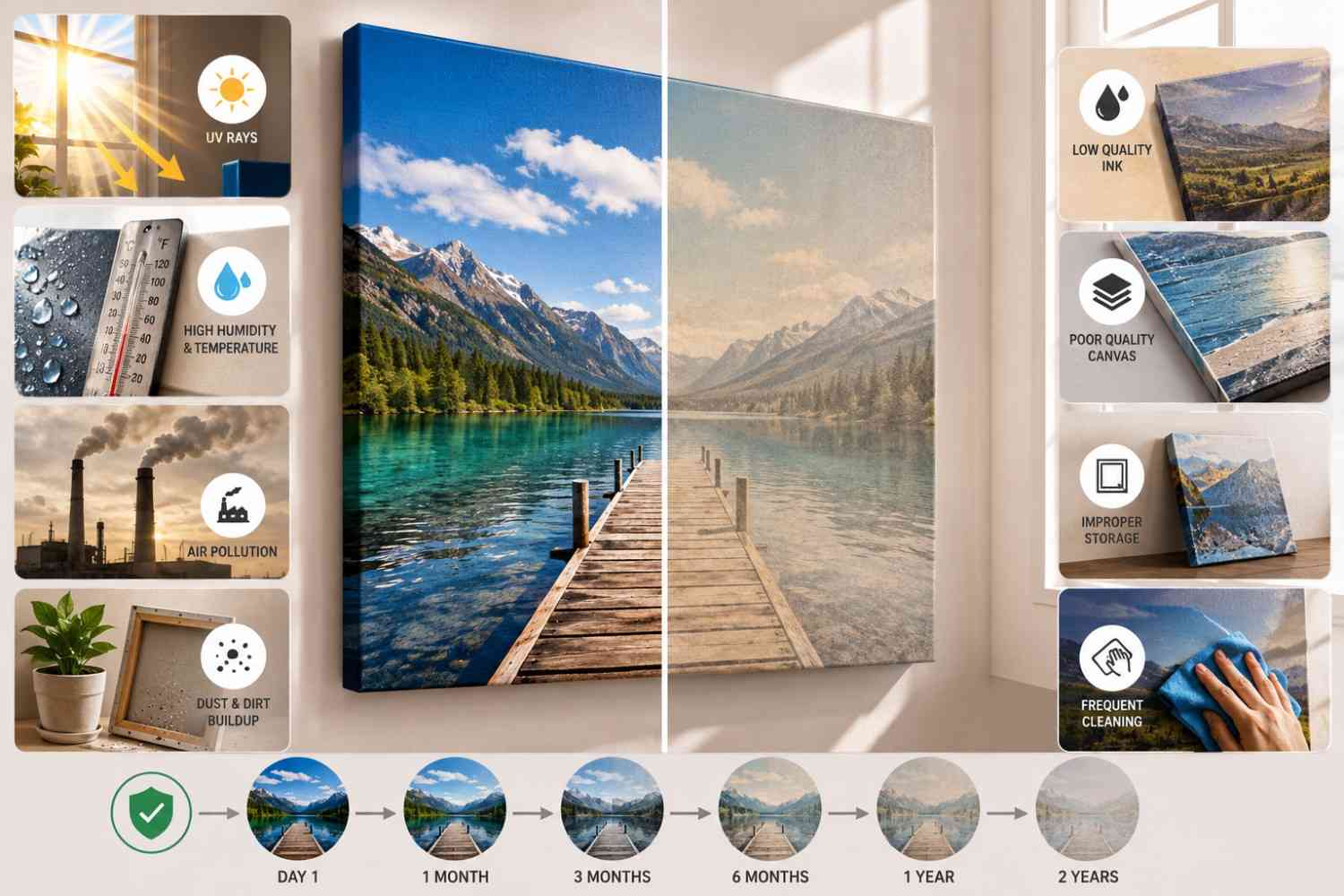
A canvas gallery wrap fades quickly due to UV radiation, poor-quality dye-based inks, cheap materials, and lack of protection. Professional canvas printing services uses pigment-based archival inks, 400 GSM archival-grade cotton canvas, accurate ICC Profiles, and UV-resistant coatings to achieve a 100+ year lifespan under controlled conditions.
What actually causes a canvas print to fade in less than a year?
A canvas print fades quickly when the artwork is exposed to UV Photolysis / UV Radiation, unstable inks, and low-quality canvas materials. I have seen cheap prints lose color accuracy because the inks break down when ultraviolet light damages pigment molecules.
Low-quality prints often fade because of unstable inks and poor materials. Professional archival canvas printing uses better media and controlled colour management to maintain artwork quality.
How does UV radiation destroy my canvas print colors?
UV Photolysis / UV Radiation is the main chemical process behind fading. I understand it as a reaction where UV energy breaks down color molecules inside the ink layer.
My canvas print can fade faster when I place it near direct sunlight, windows, or strong artificial lighting. UV exposure reduces contrast, weakens dark tones, and shifts original colors.
Are dye-based inks vs. pigment-based inks the reason my canvas faded?
Dye-based inks vs. Pigment-based inks is one of the biggest differences between consumer prints and professional artwork reproduction.
Dye-based inks
Use liquid color dyes that absorb into the coating.
Offer bright colors initially but have lower light resistance.
Can fade within months under strong UV exposure.
Pigment-based inks
Use solid pigment particles that sit more permanently on the canvas surface.
Provide better resistance against UV radiation and environmental damage.
Are preferred for archival-quality art printing.
I use pigment-based archival inks when I need long-lasting gallery-quality results.
Professional printers use advanced 11-color canvas printing technology to achieve accurate colour reproduction and better print stability.
Why do cheap canvas prints fade because of Optical Brightening Agents (OBAs)?
Optical Brightening Agents (OBAs) are chemicals added to some low-cost canvas materials to create a brighter white appearance.
I know that OBAs can degrade over time when exposed to UV radiation. The canvas may initially look brighter, but the white balance can change and cause color shifts.
Professional artwork printing avoids excessive OBAs and uses stable archival-grade cotton canvas designed for long-term color preservation.
How does professional printing prevent canvas fading?
Professional printing prevents fading by combining high-quality canvas materials, pigment-based inks, precise color management, and protective coatings.
I choose 400 GSM canvas weight because it provides the thickness and durability required for museum-quality gallery wraps.
Why is 400 GSM archival-grade cotton canvas better for gallery wraps?
Archival-grade cotton canvas provides a stable surface for professional fine art reproduction.
My preferred specifications include:
Canvas Material: 100% archival-grade cotton canvas.
Canvas Weight: 400 GSM canvas weight (standard for museum-quality wraps).
Resolution: 300 DPI resolution for sharp image details.
Expected Durability: 100+ year lifespan under recommended display conditions.
A heavier canvas structure reduces stretching issues and helps maintain print quality over time.
Choosing the right material matters for longevity. Our premium canvas options include 400 GSM canvas media designed for professional art reproduction.
Large artworks require careful material selection and finishing. Explore how an oversized Gallery Wrapped Canvas transforms premium interiors.
How do pigment inks improve canvas print lifespan?
I use advanced pigment-based archival inks because they provide stronger resistance against fading.
Professional systems use:
8 to 12-color inkjet systems like Epson UltraChrome or Canon imagePROGRAF.
Wide ICC Profiles / Color Gamut for accurate color reproduction.
High-density pigment particles for improved light stability.
These systems reproduce subtle gradients, deep blacks, and accurate skin tones while maintaining archival quality.
Why are ICC Profiles and color gamut important for preventing fading?
ICC Profiles / Color Gamut control how colors are translated from my digital file to the printed canvas.
I calibrate the printing workflow using:
Monitor calibration for accurate digital colors.
Correct ICC profile selection for the canvas material.
Printer calibration using professional inkjet machinery.
Color proofing before final production.
This prevents unwanted color shifts and keeps the final canvas close to the original artwork.
Does Liquid Laminate or Canvas Varnish protect my canvas print?
A protective layer improves resistance against moisture, scratches, and environmental exposure.
Liquid Laminate / Canvas Varnish creates a protective topcoat over the printed surface.
My professional finishing process includes:
Applying a UV-resistant liquid laminate.
Protecting pigment particles from external damage.
Increasing surface durability.
Reducing the impact of dust and humidity.
The protective coating works together with archival inks to improve the overall lifespan of the canvas wrap.
Protective finishing combined with premium materials helps create premium canvas prints suitable for homes, galleries, and commercial interiors.
How can I make my canvas gallery wrap last more than 100 years?
I can extend my canvas print lifespan by controlling the display environment and choosing archival printing methods.
What conditions protect my canvas print from fading?
I follow these preservation steps:
Avoid direct sunlight
I place canvas prints away from windows with strong UV exposure.
Maintain stable indoor conditions
I avoid extreme humidity and temperature changes.
Choose archival materials
I select pigment inks, archival-grade cotton canvas, and protective coatings.
Use professional printing technology
I prefer 8 to 12-color inkjet systems with accurate ICC Profiles / Color Gamut.
A professionally produced canvas gallery wrap can achieve a 100+ year lifespan when displayed correctly.
The finishing format also affects durability and presentation. Learn more about gallery wrap canvas vs rolled canvas before selecting your print style.
Why do some canvas prints look faded immediately after printing?
Some canvas prints look dull because of incorrect color management, poor ink quality, or unsuitable materials.
I check these factors before printing:
Image quality: Minimum 300 DPI resolution.
Ink type: Pigment-based archival inks instead of basic dye inks.
Canvas quality: 400 GSM archival-grade cotton canvas.
Printer technology: Professional Epson UltraChrome or Canon imagePROGRAF systems.
Color workflow: Correct ICC Profiles / Color Gamut settings.
FAQ: Common Questions About Canvas Gallery Wrap Fading
Why did my canvas print fade after only six months near a window?
Your canvas print likely experienced continuous UV Radiation exposure. Low-quality dye-based inks and canvas with Optical Brightening Agents (OBAs) can lose color stability much faster.
Is pigment ink better than dye ink for canvas gallery wraps?
Yes. Pigment-based archival inks provide better long-term durability compared with dye-based inks because pigment particles resist UV Photolysis and maintain color accuracy for decades.
How long does a professional canvas gallery wrap last?
A professionally printed canvas gallery wrap using 400 GSM archival-grade cotton canvas, pigment inks, protective Liquid Laminate / Canvas Varnish, and professional 8 to 12-color inkjet systems can achieve a 100+ year lifespan under proper conditions.
Leave a Reply
Your email address will not be published. Required fields are marked *